Most AI adoption stalls between experimentation and changed work. I get it moving.

Your organization has the tools. People are trying them. And somehow the workflows, the handoffs, the decisions, and the results still look about the same.

For teams that already have access to AI, the technology is no longer the hardest part. The harder work comes next: deciding what is actually worth changing, redesigning how the work moves, setting a standard for the output, and helping people operate differently after the initial excitement wears off. Often what is quietly happening instead is worse than nothing: people building un-audited workflows in personal tabs that expose your data and break the moment a tool updates.

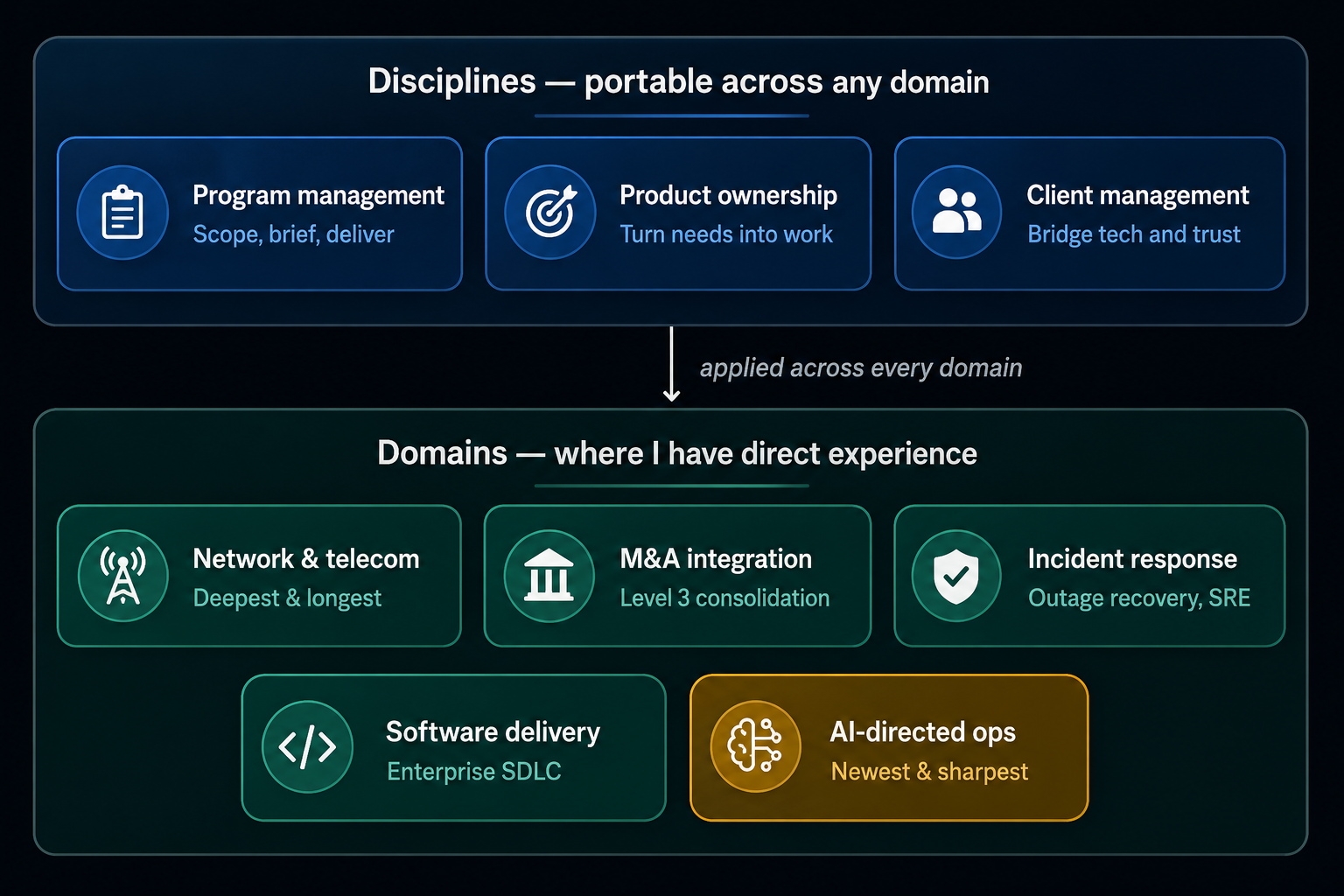
That work has a name. It is program management. Defining the outcome, briefing the work, assigning ownership, managing dependencies, holding the quality bar, and driving the change until it becomes how the team simply operates. I spent twenty-five years doing that on some of the largest technical systems in the world, including leadership roles at Microsoft, Meta, and Level 3. Now I apply the same discipline to AI adoption.

I work between your leadership, the people closest to the work, and the teams responsible for the technology. I do not sell you a platform, and I do not mistake a slide deck for adoption. I help you choose the right work, redesign it around what AI is genuinely good at, launch it in the tools you already own, and install the operating rhythm that keeps it running after I leave.

Best fit: a knowledge-work team with approved AI tools, scattered experimentation, an accountable sponsor, and at least one recurring workflow worth improving.

Not the right fit: custom model development, heavy systems integration, generic AI training, or teams already running mature AI programs at scale.

How I work with teams

Each engagement has a defined outcome, scope, timeline, and fee. Most teams begin with the AI Work Map. Teams that already have a validated workflow, an accountable owner, and an approved platform can begin directly with a Workflow Launch.

1. The AI Work Map

Find where AI creates real value, and where it would only create noise.

2. The First Workflow Launch

One important workflow, redesigned and running, owned by your team.

We take one validated workflow and turn it into a working human-and-AI operating process. Current-state and future-state design, configured inside a platform you already pay for, with clear roles, handoffs, approval and exception points, and a defined quality standard for the output. Your team learns not just how to run it, but the judgment that keeps it reliable: what to direct AI to do, what to review, and what must stay human.

You leave with one redesigned and configured workflow, documented roles and operating procedures, an output-quality rubric, team enablement, an adoption and performance scorecard, and a stabilization review after the workflow goes live.

The deliverable is not "an agent." It is a working, measured workflow your team owns. Custom software development and substantial integrations are not included unless separately scoped with a technical partner.

Scope: one workflow, one team, one approved platform.

Four to six weeks, plus a stabilization review. Fixed: $12,000.

3. The 90-Day AI Operating Rhythm

Turn the first win into a repeatable capability, not a pile of one-off experiments.

A single launch proves the value. It does not by itself create an adoption system. Over 90 days I install the management structure that lets your team choose, launch, evaluate, and improve AI-enabled workflows without it turning into an uncontrolled sprawl: use-case intake and prioritization, named owners and decision rights, an adoption and quality scorecard, an executive review cadence, coaching for managers and internal champions, lightweight operating and governance standards, and a roadmap for the next set of workflows.

The result is not another launch. It is an operating rhythm your organization keeps using after I step back.

90 days. From $15,000.

For teams that want continued senior ownership while internal capability matures, an optional Fractional AI Program Director engagement is available after the 90 days, from $4,000 per month. In that seat I hold the program-management line: sequencing the build queue, auditing prompt drift in live tools, governing token and API spend, translating board-level goals into clear briefs, and acting as the filter that catches bad internal AI ideas before they become liabilities.

Why Josh

Twenty-five years of technical program management, including leadership roles at Microsoft, Meta, and Level 3.

At Meta I led a twenty-five-person technical program-management organization and served as lead TPM during the October 2021 global outage, coordinating recovery across engineering, infrastructure, and executive leadership for services used by three billion people. At Microsoft I drove the program management behind a global network expansion across twenty-two datacenters and thirty edge locations. At Level 3 I led a seven-company integration spanning roughly 20,000 circuits.

I also use AI to run real businesses every day, and I ship it, not just advise on it. My commercial no-code AI product holds a 4.7-star rating across 50-plus reviews from paying customers, and I have written extensively on applying program-management judgment to directing AI.

My AI education products carry a 4.8-star rating across nearly 50 reviews, with a recurring theme in the feedback: people arrive overwhelmed and guessing, and leave with a repeatable methodology and the judgment to direct AI deliberately. That is the same thing I do for teams, at a different altitude.

The combination is the point: current, hands-on AI fluency backed by the operating discipline that makes change actually land.

And I will tell you where AI is not worth it. Knowing which work to leave alone is part of the value.

What I own, and where technical partners contribute

I own the business case, the workflow design, the human-and-AI decision boundaries, the quality standard, the team adoption, and the executive translation. When the work needs custom integrations, software engineering, specialized security, or substantial data work, I bring in vetted technical specialists rather than pretending those are my disciplines. I stay accountable for coordinating the engagement and delivering the adoption outcomes we scoped.

Start with the AI Work Map

If you have the tools in the building but the needle has not moved, that is exactly the gap I close. Send me three things:

  1. The target. One specific, recurring process that is dragging your team down.

  2. The headcount. Roughly how many people touch that process each week.

  3. The win. If it ran meaningfully better tomorrow, what does the business actually gain? Volume, margin, saved hours, fewer errors, sanity?

I will tell you whether the Work Map is the right first step, whether you are ready to launch directly, or whether this is not a fit and you would be better served by a self-serve tool. Either way you will get a straight answer.

josh@joshuagilliland.com

Not ready to talk yet? Start here.

If you are earlier in the process, or just want to think it through yourself first, I wrote a free guide on the hardest part of getting started: choosing the right first workflow. It is the same framework I use with clients, with a scoring tool you can run on your own team today.

The free guide to choosing your first AI workflow

* indicates required